01 / Computational modeling / March–August 2026
More energy.
More weight.
Endurance Optimization of a Small Solar-Powered UAV: does a bigger battery always mean a longer flight?
The question
A battery stores energy, but an aircraft must also carry it. I wanted to understand how those competing effects change endurance—and how the answer shifts when the rest of the design changes.
This investigation uses a computational model rather than a flight-tested aircraft. Its results describe the modeled conditions.
I completed the project individually, with guidance from mentor Yitao Zhuang, from around March through August 3, 2026.
Building the model
I defined coupled models of mass, aerodynamics, solar-energy input, and battery state of charge. The project combined a 45,325-design parameter sweep with finer validation and sensitivity analysis.
I designed the research question and modeling approach, then used AI for code generation, debugging, and language editing. The model assumptions and interpretation remained decisions I had to test and revise.
Reading the trade-off
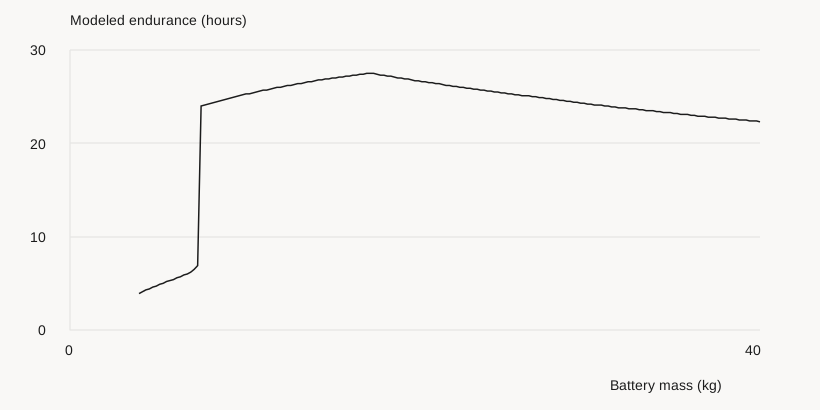
The response is not a simple rule that more battery always produces more flight time. Extra stored energy and the cost of carrying additional mass interact with the solar cycle.
The project summary reports a peak of 27.5 hours across this sweep, compared with 27.0 hours among designs passing the empty-fraction screening constraint. A raw maximum is not automatically an acceptable design.
Download the plotted data ↓Source: August 2, 2026 fine-step export. Columns: battery_mass (kg), flight_time_fine (hours), empty_fraction_ok (screening flag). The line connects sampled outputs, not a validated prediction between samples.
Rebuilding the mass estimate
The course version treated the fuselage as a 0.73 m diameter cylinder. That shortcut produced a 17.59 kg fuselage estimate. After the course ended, I replaced it with a component-level calculation and obtained 5.38 kg for the fuselage.
With the same aerodynamic, solar, and battery models, the revised mass input produced a candidate aircraft of about 41 kg total mass and roughly 72 hours of simulated endurance. The longer result came from correcting an overly heavy fuselage assumption, not from changing the energy model.
This newer result is an unvalidated simulation. The aircraft has not completed a structural check, component test, prototype build, or flight test; the first physical validation I would run is a solar-panel efficiency test.
What the results can tell us
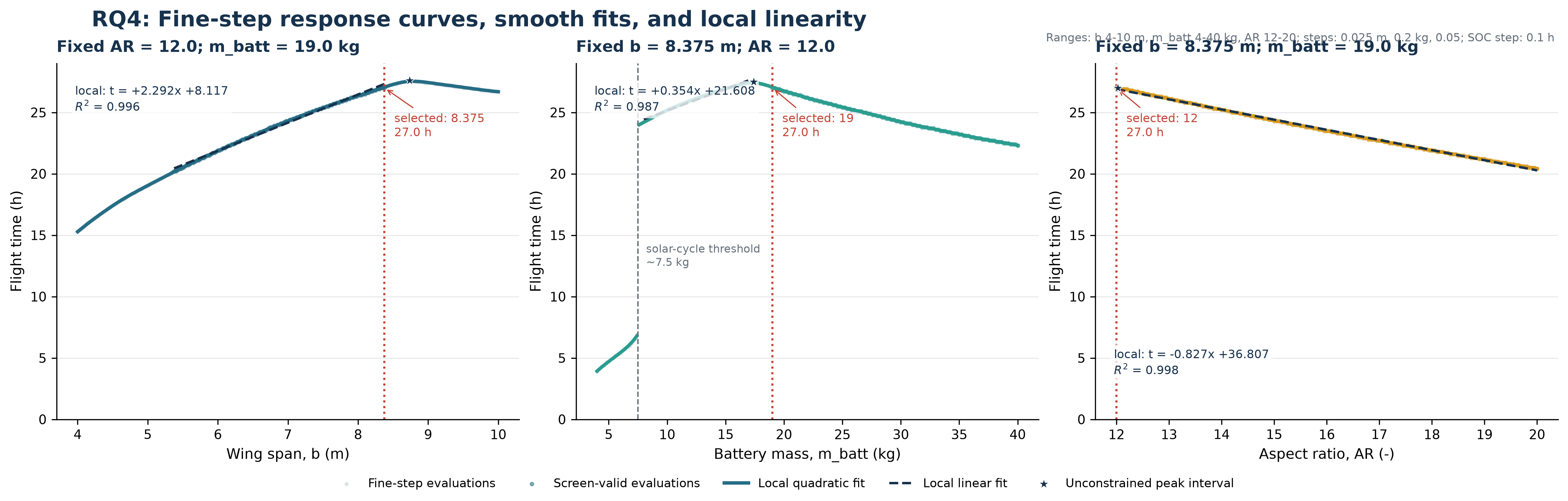
Endurance optimization requires considering the whole coupled system. Improving one component in isolation can introduce costs elsewhere.
These are model outputs under particular assumptions, not demonstrated flight durations. Physical testing and validation of the assumptions would be necessary before treating them as aircraft performance claims.
Project record
The 27.5-hour result belongs to the course research completed in August 2026. The component-level mass model and 72-hour candidate are later personal extensions. Neither result is a peer-reviewed publication or demonstrated flight duration.
Home